

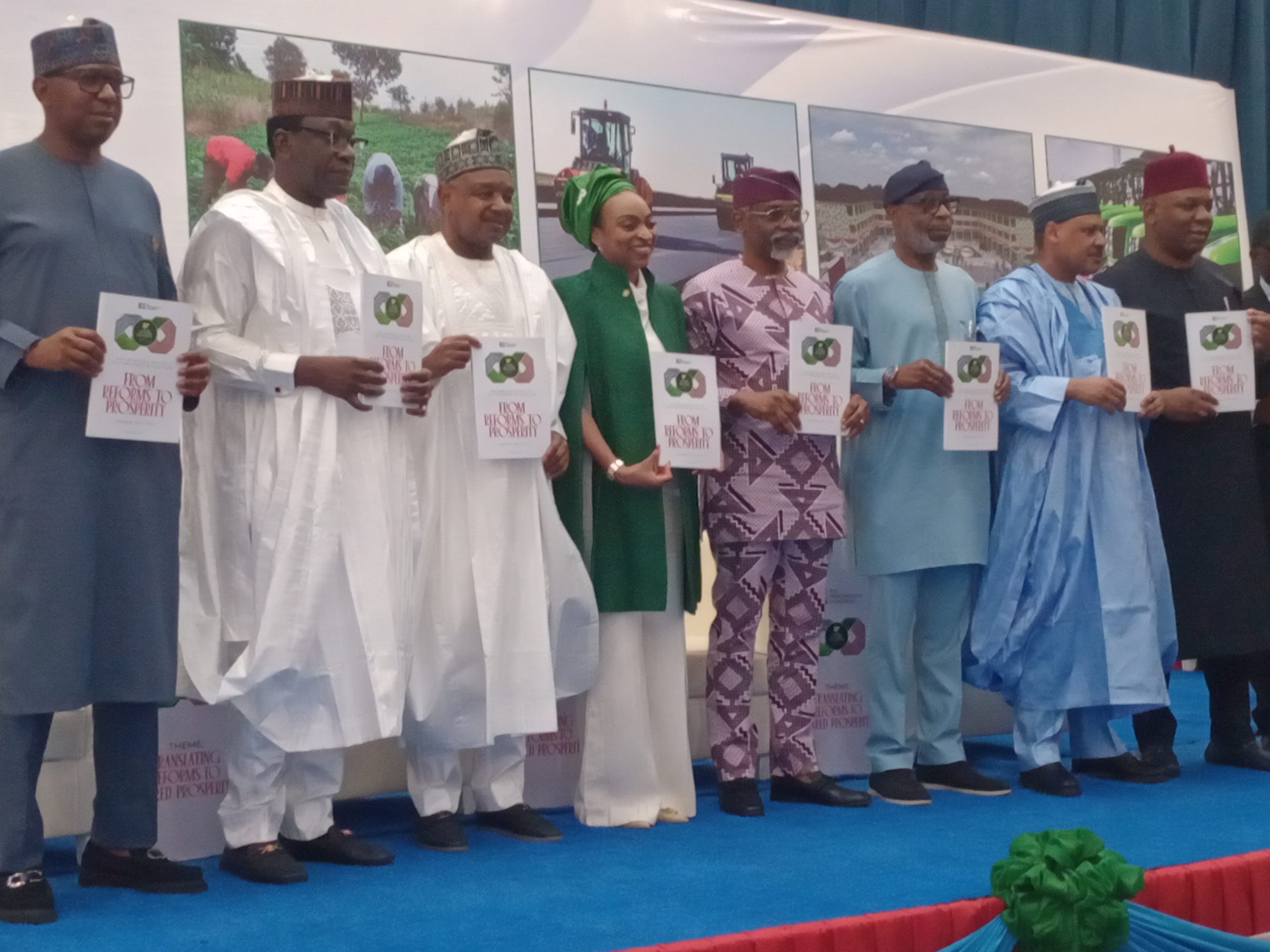
The All Progressives Congress (APC) on Tuesday openped public debate into a four-pillar manifesto outlining President Bola Tinubu’s programmes for a second term in office.
The document discussed a panel gathering in Abuja promises to reduce the cost of living, expand infrastructure, strengthen governance, and tackle insecurity between 2027 and 2031.
The manifesto titled; ‘From Reform to Prosperity Agenda 2.0’, consolidates the administration’s eight-point Renewed Hope Agenda into four policy pillars: a secure and resilient nation; a better quality and more affordable life; energy, infrastructure and economic growth; and effective, accountable governance.
The document is intended to guide in the strategic implementation of deliverable policy action and reforms during President Tinubu’s second term in office from 2027 to 2031.
President Tinubu described the programme as the next stage of reforms begun after he took office in 2023, including the removal of petrol subsidies, foreign-exchange unification and tax changes.
“The coming years must focus on tangible improvements: the food on our tables, the power in our homes, the security of our families, and the dignity of meaningful work,” he said in the manifesto.
Speaking at the ceremony, Minister of Information and National Orientation Mohammed Idris said President Bola Tinubu’s economic reforms were already benefiting Nigerians through improved security, access to education, infrastructure development and a stronger economy.
“People often ask who is benefiting from the reforms. But when roads are built, everyone can use them. When security improves, everyone benefits”, he said.
The 1.6 million Nigerian students supported through NELFUND are ordinary Nigerians, and they do not have to belong to any political party to benefit. These reforms are for all Nigerians,” the minister added.
Also speaking at the presentation, the Chief of Staff to the President, Rt. Hon. Femi Gbajabiamila, described the manifesto as a commitment between the APC and Nigerians, saying the party was presenting its record and setting out what it intended to achieve if given another mandate.
He said the document included measurable targets and a commitment to report progress to the public.
The APC’s security agenda calls for four additional Army divisions including Makurdi, Ilorin, Jalingo and Benin City, with 28,000 new military recruits and 50,000 newly recruited police officers.
It also proposes expanding police recruitment toward a ratio of one officer for every 400 citizens, while adding body cameras, digital policing systems and electronic border surveillance.
The manifesto presents those measures as a response to terrorism, banditry, kidnapping and other threats.
It also pledges to deepen community policing, though it does not detail how the new personnel and equipment would be financed.
On household costs, the APC promises to halve youth unemployment and the number of out-of-school children by 2031, train two million young people and extend digital-literacy programmes to 30 million Nigerians.
It also targets 20,000 additional teachers and an increase in health-insurance coverage to 40 per cent of the population.
The plan seeks to reduce out-of-pocket health spending from 71 per cent to below 50 per cent and make 90 per cent of primary healthcare centres functional.
It further proposes a Tinubu Mass Social Housing Scheme intended to deliver 200,000 homes across Nigeria’s 774 local government areas through public programmes, mortgage financing and private developers.
The economic pillar targets electricity generation of roughly 10,000 megawatts, wider metering, improved transmission and distribution, and expanded clean-energy access.
The party also pledges flagship industrial hubs in each of Nigeria’s six geopolitical zones, a more-than-doubling of non-oil export earnings, and one million export-linked jobs by 2030.
The manifesto projects annual economic growth accelerating to 6 per cent and commits to completing priority road, rail, port and airport projects.
Those targets would require a marked acceleration from the economy’s reported 4.43 per cent growth in the second quarter of 2026.
Our correspondent who captured the event reports that the final pillar emphasises judicial digitisation, anti-corruption efforts, local-government autonomy and digital public services.
The APC says it will publish allocations to all 774 local councils, attach baselines, targets, costs and responsible officials to each commitment, and report progress through a public delivery tracker.
The Minister of Industry, Trade and Investment, Dr Jumoke Oduwole, who presented an overview of the manifesto, said it was built around four pillars: a secure and resilient nation; a better and more affordable quality of life; energy, infrastructure and economic growth; and effective and accountable government.
She highlighted targets for stronger food security, lower living costs, expanded local production, increased exports and job creation, including one million export-linked jobs for young Nigerians by 2030.
“By 2031, we want Nigerians to see, feel and share the benefits of structural progress and economic growth. Our priorities include stronger protection against insecurity, increased domestic food production, more goods made in Nigeria, and wider opportunities for young people through trade, investment and exports,” Oduwole said.
“A manifesto is only as strong as the promises a citizen can check,” the document says.
The manifesto also cites foreign reserves of $55.3 billion as of September 2026, inflation of 14.63 per cent that month, and first-half 2026 Federation Account allocations of N18.72 trillion, up from N6.76 trillion in the same period of 2023.
