

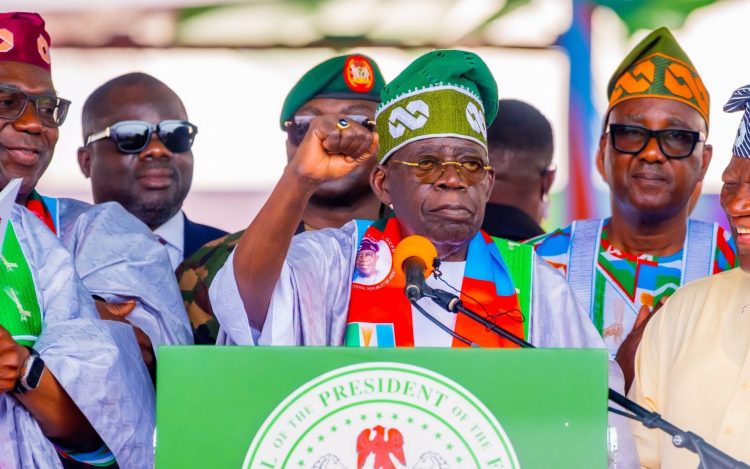
President Bola Tinubu has expanded his personal campaign schedule ahead of the 2027 presidential election, agreeing to attend 20 rallies across the country and the Federal Capital Territory (FCT), up from an initial plan of 12 states.
The revised itinerary, according to the ruling All Progressives Congress (APC) campaign timetable, marks a more extensive presidential role in the party’s nationwide mobilization.
It also signals a departure from the original arrangement, under which senior APC figures were expected to represent the president at many state-level events.
The expanded schedule adds Katsina, Taraba, Zamfara, Imo and Kwara to Tinubu’s planned appearances.
Akwa Ibom, Jigawa and Kebbi were incorporated after the president attended recent rallies in those states.
Tinubu has already campaigned in Uyo, Akwa Ibom, on November 6, where he also inaugurated projects completed by Governor Umo Eno’s administration.
He appeared in Port Harcourt, Rivers State, on November 7, followed by rallies in Dutse, Jigawa State, on November 10, and Birnin Kebbi, Kebbi State, on November 17.
Under the revised calendar, the president is expected in Katsina on December 2, Kano on December 17, Jalingo on December 19 and Abuja on December 21.
Further stops include Gusau, Zamfara State, on December 28 and Owerri, Imo State, on December 30.
The campaign is set to resume in January with rallies in Yola, Adamawa State, on January 4; Sokoto on January 5; and Ilorin, Kwara State, on January 8.
Tinubu is then scheduled to visit Asaba, Delta State, on January 11 before a concluding rally in Lagos on January 13.
The changes reflect both political calculation and pressure from APC governors.
Several state leaders had urged the president to personally commission completed projects during campaign visits, according to sources familiar with the party’s planning.
The expanded itinerary also responds to opposition claims that Tinubu’s earlier decision to limit his personal appearances was a sign that he could not withstand the demands of a nationwide campaign.
Party officials said the president wants to demonstrate that governing and campaigning can proceed in parallel.
“If you watch closely, the president has gone to states like Akwa Ibom and Jigawa and commissioned some projects,” said a source familiar with the APC Presidential Campaign Council.
“If the president wants to attend the campaigns across the country, he can do that, but he does not want to abandon governance because of campaigns.”
At the campaign council’s inauguration on October 14, Tinubu said he would make time to speak directly with Nigerians while party leaders mobilized support in states and local government areas.
He cited fiscal pressures and the need to attract investment, saying: “We have bills to pay. The American creditors cannot wait.”
The APC has scheduled 37 rallies across the 36 states and the Federal Capital Territory (FCT).
Tinubu is expected to attend 20 of them personally, leaving the remainder to other senior party figures.
The North-West receives the largest share of the president’s planned appearances, with seven states: Kaduna, Jigawa, Kebbi, Katsina, Kano, Zamfara and Sokoto.
The North-East and South-South each have three states on his itinerary, while the North-Central, South-West and South-East have two each.
The revised timetable also includes notable changes.
The Sokoto rally moved from December 5 to January 5, while the Lagos finale shifted from January 9 to January 13.
A Bauchi rally initially set for November 29, with Tinubu expected to attend, has been moved to December 1; the revised program does not indicate a presidential appearance.
Opposition parties described the expansion as evidence that the APC is adjusting its strategy under pressure.
The African Democratic Congress (ADC) presidential campaign council said Tinubu was visiting more states because its candidate, Atiku Abubakar, had intensified community-level campaigning.
“Now, Atiku has moved from state campaign to campaigning through communities, and his messages are resonating with Nigerians,” said Kola Ologbondiyan, the ADC campaign’s Director of Media and Publicity.
“It is a task President Tinubu must struggle to do to catch up”, he said.
The Nigeria Democratic Congress (NDC) was more blunt. Its publicity secretary, Osa Director, accused the ruling party of having little to present to voters and warned the APC against political overconfidence.
“The APC should learn from history,” Director said.
“When you think that you are too smart, at the least expected time you will out-dribble yourself.”
However, the enlarged itinerary gives Tinubu a more visible national platform as the party seeks to convert presidential presence into electoral momentum ahead of 2027.
