


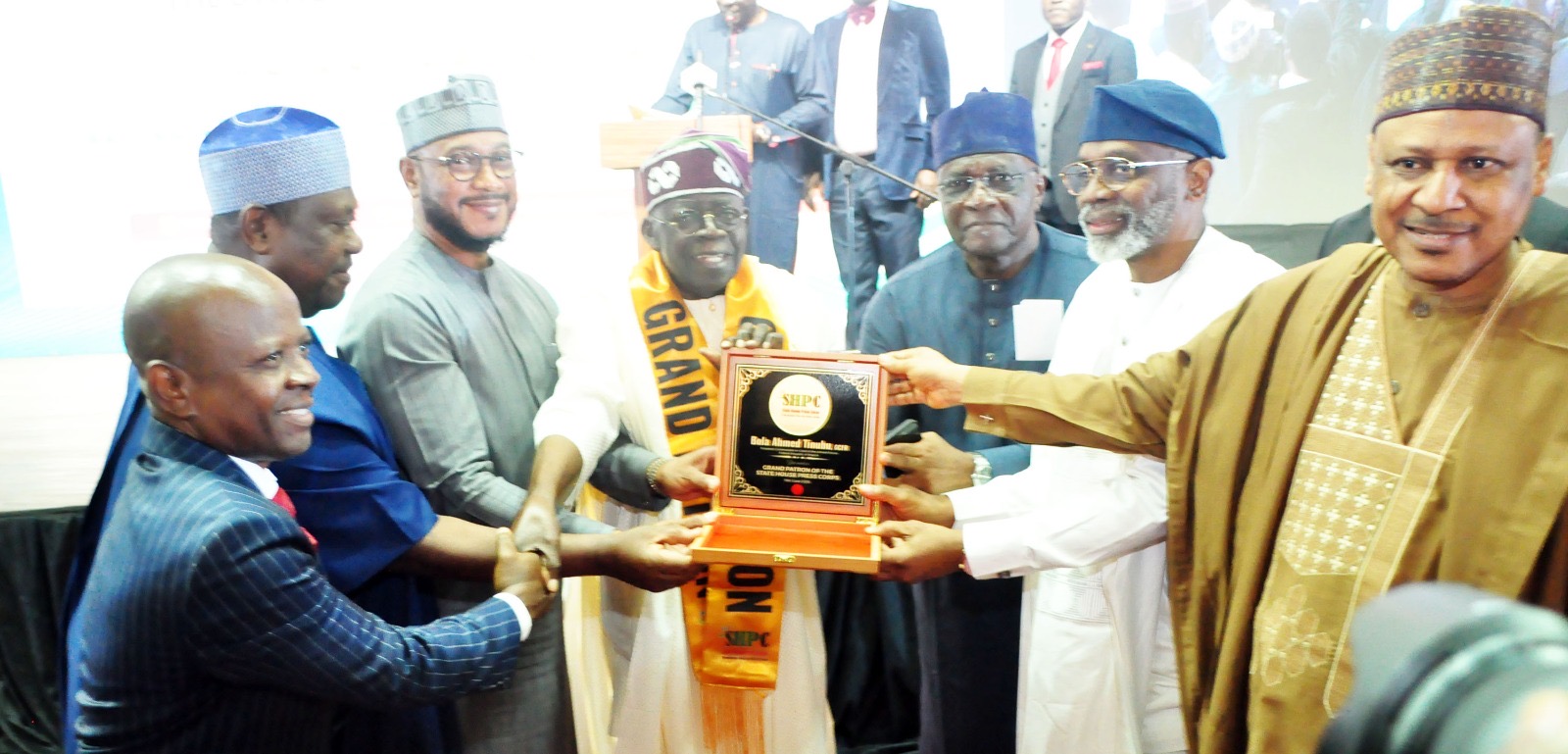


By Anule Emmanuel
After weeks of uncertainty and three postponements that kept guests waiting for the maiden presidential press corps dinner—held in a colourfully decorated setting, President Bola Tinubu made a polished appearance at the 2026 edition of the event, a reminder of the presidency’s staying power also as an instrument of political theatre.



The event was co-hosted by the Chief of Staff to the President Rt. Honourable Femi Gbajabiamila and the Minister of Information and National Orientation Mohammed Idris, on behalf of the Presidency, as support to gentlemen of the press.
It was a story of how maiden events often play out. They are usually not merely a beginning but a statement of declaration of possibility. A statement that the first step may be modest, but could lead to an extraordinary journey.
As hundreds of guests, dressed smartly and elegantly, sat inside the heavily air-conditioned State House Conference Centre for the dinner on 19 June 2026, not a single official—including members of the State House Press Corps (SHPC)—knew about the next move: a presidential decision.
The fits and starts prompted speculation that the Special Guest of Honour—President Bola Tinubu—and his dear wife, First Lady Oluremi Tinubu, would not attend the ceremony. Credible sources earlier indicated that the president and the First Lady were dressed for the dinner but were waiting for go ahead signal from protocol officials.
It was now an hour of rumour and low tone whispering about a possibility that Mr. President might have decided to skip the evening altogether. This prospect, left a few guests disappointed with several senior journalists also trading conjecture about reasons for his action.
However, several high‑profile VIPs did not attend the dinner on Friday June 19. The entire front row—designated for the top guests and adjacent to the seat of the Special Guest of Honour—remained empty. Protocol officials viewed this as un‑presidential. Who is to blame for their absence? These personalities had been duly invited each time the event was rescheduled. The dinner date was changed twice before Friday 19 June.
Then a call came from one of the President’s close media aides. “We will have to reschedule the dinner. The President is still set to attend, but the report he is receiving suggests a more appropriate arrangement is needed to meet the required standards.”
A few presidential aides went to meet the Special Guest of Honour in an apparent effort to persuade him to attend. Their intervention yielded a commitment to a more suitable date. The dinner has therefore been rescheduled for two weeks’ time, with the Presidency undertaking to ensure its resounding success, Chief of Staff to the President Femi Gbajabiamila informed members of the SHPC as guests awaited with keen expectation.
When the rescheduled evening arrived on Thursday 2 July 2026, President Tinubu and Mrs. Oluremi Tinubu graced the Conference Center for the historic dinner – where senior government officials and journalists covering the presidency had gathered, combining institutional recognition, speeches and lighter social interaction. The President’s presence validated his earlier insistence that the dinner would proceed, highlighting the importance of presidential backing for staging such occasions.
Unlike the American version of the White House Correspondents’ Dinner, the Aso Rock gathering retained a notably decorous atmosphere: formal addresses and measured commentary predominated, punctuated only occasionally by levity from a handful of the speakers.
The tone reflected both local political culture and the high stakes of proximity to power in a capital where image-management remains crucial.
Dr. Anule Emmanuel, chairman of the State House Press Corps, set a reflective tone, invoking metaphor to cast the President’s electionn2023 victory as an uphill contest won with decisive margins — a turn of phrase that elicited both knowing nods and good-natured laughter from the guests.
“Mr. President, we share certain political milestones. You were overwhelmingly elected President in 2023; in that same year I was elected, by a similarly decisive margin, as Chairman of the State House Press Corps. In May this year, you completed three years of your first term, and I have now served three years as chairman,” Dr. Anule said. The chairman’s remarks were a reminder that the press corps still sees itself as a mirror to political developments even as it courts access.
Light-hearted ribbing provided much of the evening’s colour. President Tinubu’s Chief of Staff seized the occassion on stage as he joked about Dr. Anule’s ‘vertically challenged statue,’ quipping a comparison with Senator Adams Oshiomhole – a quip that prompted audible amusement across the hall. The Secretary to the Government, George Akume, then followed with his own mordant line, dubbing Dr. Anule ‘the shortest journalist in Africa,’ a remark that landed as pointed jocularity in a room finely attuned to rank and social position.
President Tinubu himself seized the moment of the evening with comedic exchanges. Right through his opening protocol salutations, the President’s remark directed at his wife was a national trending issue that seem to have become a controversy surrounding the First Lady’s June 2026 remarks promoting small-scale businesses such as frying akara (bean cakes) as part of a government empowerment programme.
While discussing a federal grant scheme for petty traders, Mrs Tinubu announced that the government was trying to ‘give hope’ and noted that ‘to start an akara business doesn’t take a lot of money,’ adding that similar low-capital ventures included roasting corn and making kuli-kuli.
The First Lady’s comments quickly went viral and drew sharp criticism on the social media, with many Nigerians especially members of the opposition political parties arguing that the suggestion appeared out of touch amid high inflation, food insecurity, and widespread economic hardship. Critics argued that her remark attempted to reduce national economic solutions to street-level snacks.
President Tinubu would not miss the opportunity of this relaxed atmosphere to joke away this seemingly national debate. He called his wife ‘Iya Akara’ — literally ‘mother of akara,’ a playful, familiar sobriquet that drew laughter and softened proceedings at the dinner.
The joke, delivered with a practiced geniality, further served to humanize the President and reinforce the carefully managed blend of accessibility and authority that the administration seeks. With the presidential joke, the matter has since faded out of public debates.
The President also used the occasion urging journalists to prioritise national interest, avoid sensationalism, and resist becoming mouthpieces for criminal groups, while also affirming press freedom.
President Tinubu’s sterling remarks were the centrepiece of the dinner. His appearance with his wife and other high‑profile attendees, including members of the diplomatic corps, also highlighted the event’s significance, which is now expected to become an annual ritual.
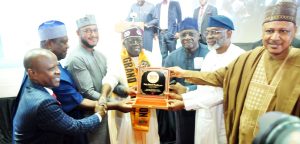
The selection of honorees at the dinner’s inaugural edition bolstered the event’s credibility, spotlighting figures whose financial clout, policy stewardship and philanthropic reach have shaped Nigeria’s public life. Among the recipients were Aliko Dangote, Africa’s wealthiest businessman and president of the Dangote Group, recognised for his sizeable investments that underpin the country’s energy security; Nyesom Wike, minister of the Federal Capital Territory, honoured for transformative infrastructure projects across the capital; Tony Elumelu, chairman of the Tony Elumelu Foundation and Heirs Holdings, lauded for philanthropy that has catalysed youth entrepreneurship across the continent; and Alhaji Atiku Bagudu, Minister of budget and economic planning, acknowledged for efforts to strengthen fiscal efficiency. Additional commendations went to Interior Minister Olubunmi Tunji-Ojo; former presidential media adviser Olusegun Adeniyi; Felix Onuah, a retired senior correspondent for Reuters; the late Abubakar Ladan of Triumph Newspaper; and Dr. Anule Emmanuel, chairman of SHPC, who was singled out for exemplary leadership.
Nigeria now has its own version of presidential press corps banquet—that citizens and stakeholders, particularly those within the media industry, anticipate attending beginning next year. This is significant not just as a social gathering, but as a new civic and media tradition in Nigeria’s democratic life.