








Nigeria’s new strategic engagement with the United States over critical minerals carries promise, but it is not a blank-cheque arrangement, writes Anule Emmanuel.
Nigeria’s new critical-minerals framework with the United States of America is neither a mining windfall nor a surrender of sovereignty. More usefully, it is an invitation to determine whether the country is prepared to convert its considerable geological endowment into industrial capacity, jobs, and durable national wealth.
Understanding the importance of the New York minerals deal may help many naysayers who have yet to grasp the relevance and immense value to the nation of the Federal Government’s recent engagement at the just-concluded 81st United Nations General Assembly (UNGA).
For too long, Nigeria’s extractive imagination has been trapped by oil: find a commodity, export it in raw form, share the rents, and then wonder why little of lasting value remains when prices fall or reserves decline.
The global rush for critical minerals offers an opportunity to write a different story. But a Memorandum of Understanding (MoU), however promising in its diplomatic language, will not excavate a tonne of lithium, refine a gram of rare earths, build a road to a mine or protect a community from the social and environmental costs of extraction.
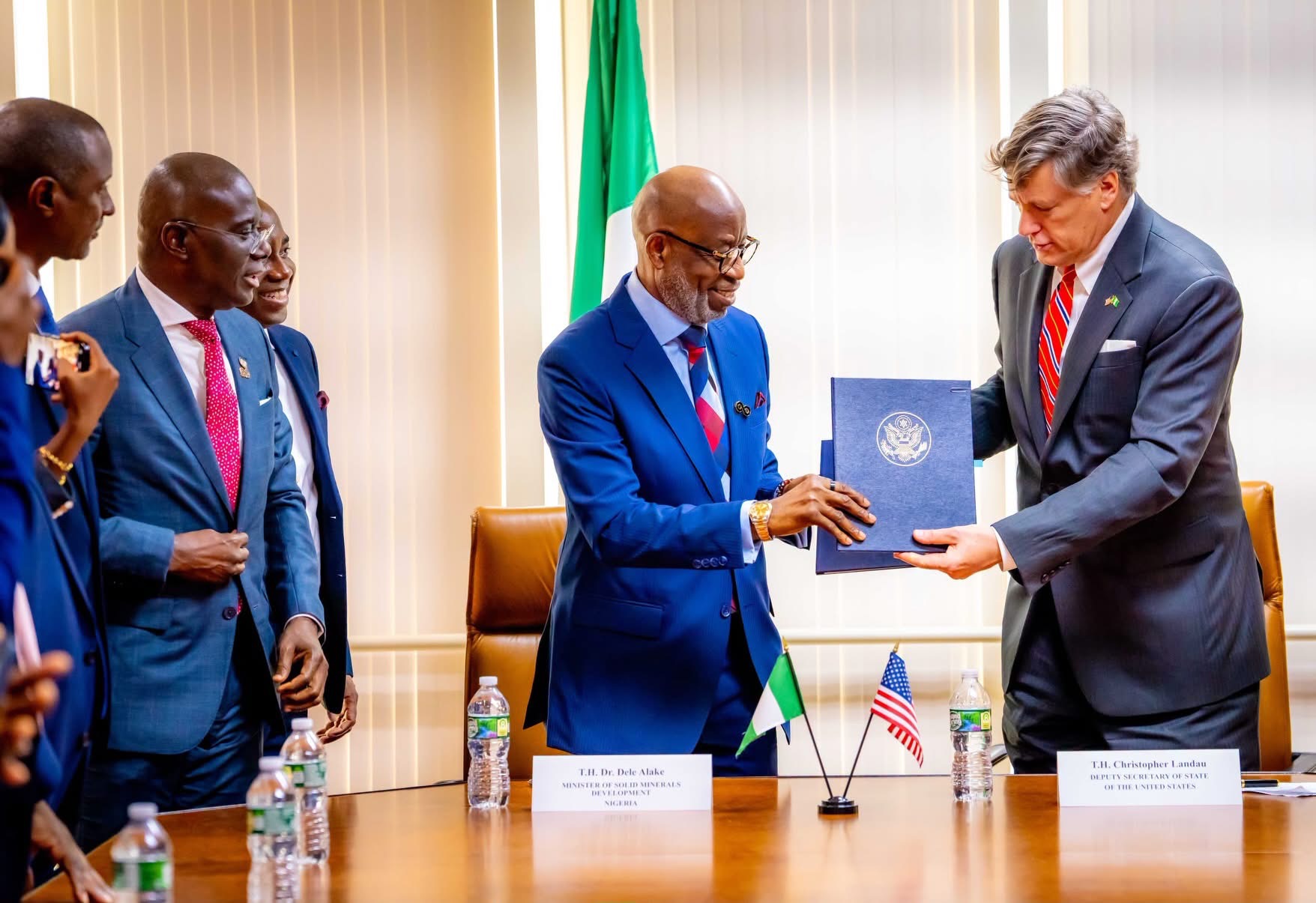
In New York, Minister of Solid Minerals Development Dele Alake joined the US Deputy Secretary of State, Christopher Landau, to sign an agreement aimed at deepening American investment in Nigeria’s mining sector.
Alake, who enthusiastically announced the development on his official Facebook page, the agreement is an important step in strengthening Nigeria-US cooperation around the nation’s mineral resources, valued at about $700 billion.
The framework covers geological data and exploration, mineral development and processing, infrastructure, and technical capacity.
According to Alake, President Bola Tinubu and his administration strongly believe that Nigeria cannot remain a source of raw materials while others capture most of the value.
“We want more local processing, quality jobs, stronger skills and greater opportunities for Nigerian businesses. In the coming months, we will turn this framework into projects, investments and real results for our people,” the Minister said.
Working with the subnationals, the Federal Government intends to quickly identify viable projects and build partnerships that create value for Nigerians and US partners. The effort is a deliberate step towards converting the country’s mineral wealth into lasting economic growth and advancing the diversification goals of the present administration.
The MoU between Nigeria and the US is not a free pass; it requires a great deal of work from the Federal Government. One point needs to be stated plainly, especially amid the inevitable political noise that accompanies any Nigeria-US commercial understanding.
The arrangement reached during UNGA-81 is not a blank-cheque deal, a concession of Nigeria’s mineral wealth or an exclusive supply contract under which Washington acquires privileged rights to the country’s underground resources.
NewsQuest gathered that it is, rather, a non-binding framework, closer to an MoU than a binding commercial agreement, that sets out areas in which the two countries may cooperate where their interests overlap.
These include investment in mining, support for mineral processing, technical expertise, stronger governance, improved regulation, finance, and the wider policy environment necessary to attract serious operators.
The United States is seeking to reduce its strategic dependence on concentrated sources of minerals required for electric vehicles, batteries, renewable-energy equipment, advanced electronics, defence manufacturing and other technologies that will increasingly determine economic and geopolitical power.
America’s official critical-minerals list includes dozens of commodities such as lithium, cobalt, nickel, graphite and manganese, which are essential for electric-vehicle and stationary-storage batteries; copper and aluminium, used in power grids, wiring, electrification and vehicles; and neodymium, praseodymium, dysprosium and terbium, which are used in permanent magnets for wind turbines, electric vehicles and defence systems.
Others are gallium, germanium and indium, which are essential for semiconductors, fibre optics, and satellite and communications systems.
There are also uranium, used as fuel for nuclear energy; titanium, tungsten, tantalum and niobium, which are essential for aerospace, defence, high-strength alloys and electronics; silicon, silver and tellurium, used in solar technologies and electronics; as well as potash and phosphate, which are important for fertiliser and food security.
Nigeria, according to geological assessments and exploration data, has potential across a broad range of these critical minerals, albeit with varying levels of proven reserves, accessibility, commercial viability and processing requirements.
Potential, however, is not production. A mineral occurrence is not a mine. A mine is not a profitable project. And a profitable project does not automatically translate into national development. Nigeria has learned this lesson the hard way from oil.
The country’s critical-minerals prospects are often described in the language of abundance: lithium, tin, tantalum, niobium, graphite, gold, rare earths and other deposits scattered across several states. But operators in the sector understand that the real asset is not only in the ground. Minerals beneath Nigerian soil are only one part of the equation. In some respects, they are not even the decisive part. What investors need is certainty above ground.
That means credible geological data; clear and enforceable licences; stable fiscal terms; security around mining sites; reliable electricity; transport links; access to water; predictable export procedures; and institutions able to distinguish between legitimate mining, speculative licence-holding and outright illegal extraction. It also means resolving the chronic tension between federal control over mineral resources and the understandable demands of host states and communities for a fair share of the gains, as well as protection from the disruption mining can bring.
Without these foundations, the nation may discover that its mineral wealth is valuable mainly to middlemen, informal miners and foreign processors. The country would export raw ore, import finished products at a premium, and call the transaction investment.
The more ambitious aim must be to use external demand, including American demand, as leverage to build domestic capability. This is the context in which the recent framework signed in New York between Nigeria and the US should also be understood.
If the United States wants secure supplies, Nigeria should want secure investment, local jobs, modern processing plants, trained geologists and engineers, transparent revenue systems, industrial infrastructure and meaningful technology transfer. A framework can support that ambition. It cannot substitute for it. Washington has an interest; Nigeria has a choice.
The Federal Government, therefore, has no reason to apologize for pursuing a relationship with the United States in this area. Washington’s interest is strategic, but so is Nigeria’s.
A country with a large population, a struggling foreign-exchange position and a pressing need for productive employment cannot afford to treat mining merely as another export pipeline, nor is the country obliged to choose between America and the rest of the world.
Those raising concerns about potential threats to national sovereignty should also come to terms with the fact that such a framework would not prevent Nigeria from maintaining commercial and diplomatic relations with China, the European Union, Britain, Gulf investors, India, Japan, South Korea, or any other country prepared to invest on acceptable terms. Nor would it make the United States Nigeria’s exclusive buyer or require Nigeria to surrender control of its mineral policy.
The value of a non-exclusive framework lies precisely in the room it leaves Nigeria to negotiate from a position of choice. But choice matters only if it is exercised intelligently.
The real significance of the Nigeria-US framework will be measured not by the communiqué or the photographs accompanying its signing, but by the first serious projects it helps to unlock.
Neither side is offering charity. Both are pursuing their interests. That is not a weakness of the framework; it is its reality. That is why private-sector case studies will also matter.
Ultimately, the New York deal will be judged not by whether Nigeria has signed another document with a powerful partner, but by whether it has finally learnt to negotiate from the ground up: beginning with what lies beneath its soil, but ending with factories, skills, jobs, public revenue and communities that are better off than before. That is how the country can maximizegrowth, diversify its economy and improve millions of lives.