


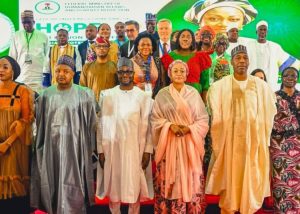



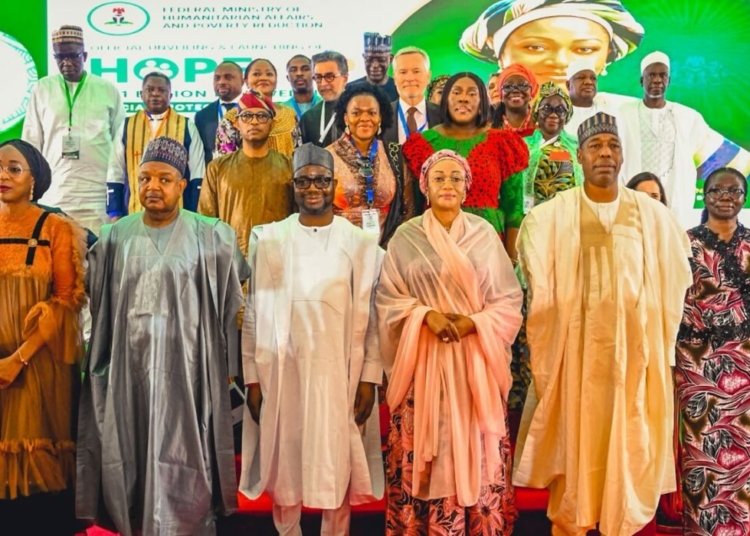


The Federal Government on Wednesday rolled out a consolidated national social‑protection framework centred on a $1 billion programme intended to identify poor households, eliminate overlap between aid schemes and track beneficiaries until they achieve economic self‑reliance.
Minister of Humanitarian Affairs and Poverty Reduction Bernard Doro, unveiled the Household Prosperity, and Empowerment Social Protection Project (HOPE‑SP) alongside four complementary initiatives; the One‑Humanitarian‑One Poverty Response System (OHOPRS), an Emergency Cash Transfer Programme, the ministry’s Ministerial Blueprint, and a new Humanity First magazine.


He said the package represents a shift away from one‑off palliatives toward a systematic, data‑driven approach to poverty reduction.
“The objective is to move from programmes to households, and from counting beneficiaries to measuring impact,” Minister Doro told reporters.
He described a model that places the household at the centre of assistance and follows families along a defined “poverty graduation” pathway.
Under that model, beneficiaries would be identified in a unified register, receive tailored support and be monitored through a digital delivery system until they move into a growth register.
First Lady Oluremi Tinubu while speaking at the event, described the reforms as a necessary complement to the administration’s broader economic changes.
“It is designed to provide immediate stabilisation assistance while placing the households on a pathway to recovery, empowerment and self‑reliance,” she said, adding that the measures aim to keep vulnerable Nigerians from becoming permanently dependent on state aid as President Bola Tinubu’s reforms reshape the economy.
Minister Doro had said fragmentation across ministries, departments and agencies had produced multiple, uncoordinated beneficiary lists—allowing some households to receive several interventions while others were overlooked.
The new architecture, anchored on a National Social Register that he said already lists about 20 million households, will integrate existing databases and provide a single window for coordinating emergency relief, social protection and poverty‑reduction efforts.
The ministry also announced plans for a National Poverty Intelligence Lab to supply real‑time data and analysis to guide interventions.
Budget and Economic Planning Minister Atiku Bagudu in his remarks said the initiative’s effectiveness will hinge on co‑operation across federal, state and local governments, and with development partners.
He linked the effort to the administration’s ambition to grow Nigeria’s economy to $1 trillion by 2030, saying expanded economic opportunity at the grassroots will be essential to that goal.
Bagudu also noted that global shocks—citing the Russia‑Ukraine war and instability in the Middle East—pose risks to household incomes and heighten the need for anticipatory social‑protection systems.
Borno State Governor Babagana Zulum, whose state faces long‑running humanitarian challenges from insurgency, said sustainable peace requires tackling the socioeconomic drivers of insecurity:
“Emergency interventions alone will not be enough,” he said.
NewsQuest reports that the new architecture is expected to improve accountability, reduce duplication and provide clearer measures of whether social programmes are improving lives.


