

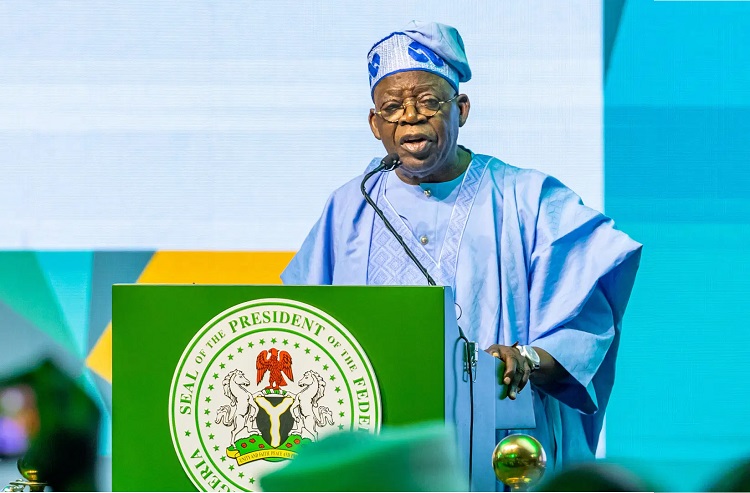
President Bola Tinubu has called on African nations to move beyond reliance on foreign space technology and build domestic capabilities in satellite manufacturing, research commercialization and space-based services, as the global space economy is projected to reach $1.8 trillion by 2035.
Speaking at the opening of the Africa Space Economy, Innovation and Communication Conference 2026 in Abuja, Tinubu, represented by Secretary to the Government of the Federation George Akume, said Africa could no longer remain a passive consumer of technologies developed elsewhere.
He urged governments to attract private capital, commercialize scientific research and deepen cooperation across the continent.
The global space economy is currently valued at $686 billion, according to the president.
He said the sector offers African countries opportunities to accelerate growth, improve security and support sustainable development, but warned that the benefits would depend on turning research into marketable products and viable businesses.
“We must translate the outcomes of our scientific research and technological development into marketable products, viable enterprises, and solutions to real-world challenges,” Tinubu said.
Tinubu said Nigeria had built expertise in satellite technology, Earth observation and satellite communications, trained scientists and engineers, and launched and operated its own satellites through the National Space Research and Development Agency.
He said the next priority is industrialization and commercialization, so the country can extract greater economic value from its investments.
The President also unveiled models of Nigeria’s next-generation satellites, which he said would strengthen the country’s ability to monitor land and water resources, assess climate-change impacts, track environmental degradation and support national security.
The platforms are also expected to aid urban planning and improve mapping of Nigeria’s solid-mineral resources.
Tinubu linked the sector’s development to his administration’s goal of building a $1 trillion economy by 2030.
He said space technologies could create new revenue streams, reduce revenue leakages, improve resource management and support evidence-based policymaking.
The President urged African countries to use the African Space Agency and other regional platforms to pool resources, align policies, share expertise and develop joint programs.
He said such collaboration would give the continent the scale needed to compete with established global space powers.
Nigeria, he said, would pursue strategic partnerships and memoranda of understanding to expand collective capacity, promote knowledge exchange and unlock investment.
For investors and industry leaders, Tinubu pointed to Africa’s rising demand for space-enabled services, its growing pool of skilled professionals and its development needs as opportunities for profitable investment and innovation.
He also challenged young African scientists, engineers and entrepreneurs to take a leading role in the sector.
“The future of Africa’s space economy belongs to you as much as it belongs to established institutions and governments,” he said.
The three-day conference is expected to focus on Earth observation, satellite communications, Global Navigation Satellite Systems, geospatial data, artificial intelligence, space manufacturing and workforce development.
Tinubu asked participants to produce practical outcomes, including investment pathways, viable partnerships, stronger institutional collaboration and actionable policy recommendations.
He said the decisions reached would help determine whether Africa merely observes the global space economy’s expansion or becomes an active and competitive participant.
He also received the Space Grand Commander Award, which organizers described as the first of its kind in the history of space science.
