






By Anule Emmanuel
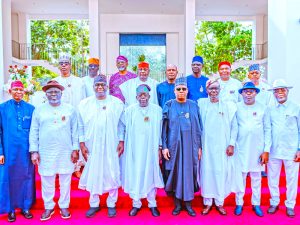
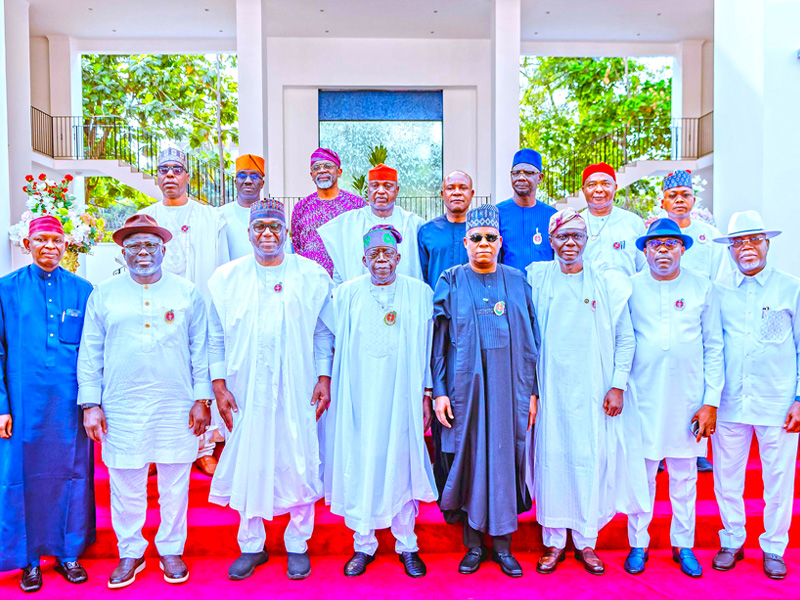
They met in the cool, security‑ringed rooms of the Presidential Villa with the guarded courtesy of men who know power’s rituals and the urgent business of keeping it. On a Thursday that might have been an unremarkable day in the nation’s capital, critical stakeholders and Governors of the All Progressives Congress (APC) filed into the Presidential Villa and emerged with a simple, emphatic message: they are united behind Bola Tinubu and confident of delivering him a second term.


The gathering – part governance update, part campaign strategy meeting, was emblematic of a campaign that is being staged, explicitly and implicitly, at the State and local levels ahead of the 2027 general election.
Imo State Governor Hope Uzodimma, who also serves as Director-General of Renewed Hope Ambassadors (RHA), the civic engagement movement set up to translate Federal reforms into popular understanding, spoke for the group.
“All the APC Governors are solidly behind Mr. President,” he told State House correspondents.
“The responsibility of delivering the election lies on the shoulders of the Governors at the subnational level,” Uzodimma stressed.
That claim is more than bravado. With 31 Governors elected on the APC platform out of 36 States – roughly 86 percent of the country’s governorships, the party’s state‑level machinery is formidable. In Nigeria’s presidential contests, Governors are rarely the decisive single factor; their power is structural and conditional rather than absolute. Yet they preside over the levers that turn votes into results: party apparatuses, local government networks, patronage systems and the logistical capacity to mobilise turnout on election day.
Political operatives like to say that ‘elections are not in Abuja. They are in the States.’ The Villa meeting was an admission of that reality.
The APC Governors’ visit followed a National Economic Council (NEC) session chaired by Vice‑President Kashim Shettima, during which critical policy decisions were made including, an approval to upgrade 13 police training facilities nationwide.
Conversation in the APC meeting after NEC, Uzodimma said, split between politics and governance, with governance taking precedence. The minutes were predictably focused on alleviating immediate pressures felt by Nigerians: the cost of living, transport, food security and agricultural productivity.
The tenor was also managerial as much as it was electoral. “We spoke basically on two issues: one, politics, and the other, governance,” Governor Uzodimma said. “Governance…is about how to reduce the cost of living in Nigeria, the cost of transportation, food security, agriculture – bringing prosperity to the people.”
A statement from Bayo Onanuga, the President’s Special Adviser on Information and Strategy, said the Governors had carried out an impact assessment of the administration’s policy reforms and flagged areas for improvement. The assessment, Onanuga noted, was not only about problem‑spotting; it was an endorsement of the administration’s reform agenda and a rehearsal of talking points that will be used in the campaign’s next phase.
The public performance of unity came as the APC on August 22 unveiled the structure of its Presidential Campaign Council, with Tinubu as Chairman and Vice‑President Shettima as Vice-Chairman. Former Zamfara State Governor Abdulaziz Yari was named Director-General and Governor Uzodimma secretary; the rest of the team is stacked with deputy directors and zonal coordinators tasked with mobilisation, media and election planning, across the nation’s six geopolitical zones. In party terms, this is a conventional play: convert federal reach into local organisation and, in the lingo of campaign managers, “own” the states.
For the Governors themselves, the meeting was both an affirmation of influence and a practical coordination exercise. Nasarawa State Governor Abdullahi Sule, who joined Uzodimma in re‑echoing support for President Tinubu, emphasised the administration’s plans to expand gas utilisation, particularly compressed natural gas (CNG), and pressed themes of party unity and poverty reduction. The message was calibrated: policy deliverables feed the narrative of competence which, in turn, underpins the mobilisation pitch.
In July this year, President Tinubu secured a high‑profile endorsement from Northeast leaders who vowed to mount grassroots mobilisation for the Tinubu‑Shettima ticket. Led by Borno State Governor Babagana Zulum and former SGF Ambassador Babagana Kingibe, that delegation’s support illustrates the geographic breadth of the administration’s alliances. Kaduna State Governor Uba Sani went even further, predicting that Tinubu would capture what he described as an “overwhelming” share of votes in his State. At a recent project launch Governor Sani claimed that President Tinubu would take as much as 95 per cent of Kaduna’s vote – a rhetorical flourish that underlines how Governors elected on the platform of the APC are already selling inevitability to their constituencies.
Outside the Presidential Villa, the political arithmetic also looks favourable to incumbent President Tinubu.
Polls and prediction markets that are publicly available place Tinubu as a frontrunner, with estimated probabilities of victory commonly reported in the mid‑60s to low‑70s percentage range. Multiple factors feed that assessment: a unified APC machine, a fragmented opposition that risks splitting the anti‑incumbent vote, and the material reach of federal programmes that can be pointed to as evidence of competence.
With Governors, party leaders and regional power-brokers now publicly aligning behind President Tinubu, the APC moves into the 2027 campaign with a clearer, state-level roadmap for mobilisation. As they left the Villa, the Governors could plausibly claim to have enshrined themselves as the APC’s engine for 2027.
The meeting at the Villa and the campaign structure unveiled days earlier also demonstrates how the party plans to convert administrative reach and federal reforms into votes on the ground.
Whether that strategy will translate into the margins that current forecasts predict remains to be tested on election day, but for now, the governing party’s unity and the Governors’ message obviously have strengthened President Tinubu’s standing as the presumptive leader in a contest many expect to be closely fought.


